The Conundrum
With so much emphasis on reducing emissions and your carbon footprint, we have to call into question the lifestyle and practical decisions we make on a daily basis. Transport is one decision we often take for granted and does warrant some consideration in an age where consuming less is becoming more important. For some, consuming less is a bible to live by and for others it is yet another potential source of guilt that turns our ears red whenever it is discussed. No matter where you sit on this spectrum, generally it is both environmentally and economically wise to at least consider environmental impact in your transport decisions.
For the record, I wouldn’t blame you for switching off now when you start reading an article about carbon footprints written by a ‘car guy’ who runs a car servicing company. After all, my motivation here is vexed. I make my living from cars and yes I like them. I have a track car and hitting the race track is my favoured form of stress relief. I guess you could suggest I am not wearing a green heart on my sleeve. Be that as it may, I still look at the world as a place that needs our love and this article is my journey towards finding a happy medium between a love of cars and leaving the world a better place.
It starts here
Transportation is important. Obviously! Whether it be just getting from A to B, walking around your neighbourhood (no more than 5 kms from home as I write this in Melbourne’s stage 4 lockdown), riding a bike for transport, fun or sport, freighting goods, going to see loved ones or just exploring the big wide world, our incessant need to move about is a pivotal part of our existence. Whole social structures have been developed around it and nations have been built because of it. We are where we are now because of our past transport decisions and our future depends on where we go from here.
So how do we make a better transport choice based on what is available to us now? Let’s look at that. Electric vehicles, plug in hybrids, hybrids, petrol and diesel, public transport, push bikes, skateboards, feet are all options we have. Cars as we know them are not going to be the only way to get around into the future. Driverless vehicles will be a game changer that could revolutionise public transport into an on demand system. However, for now, cars are convenient. If the current pandemic does bring major structural changes to the way we live, we may well use cars less but rely on them more as we work more from home and move regionally to places where public transport is not as efficient.[/vc_column_text]
How do you measure a car’s carbon footprint?
You can measure a car’s carbon footprint by analysing its life cycle. Generally, a car’s lifecycle has three distinct phases: manufacture, use and end of life. To flesh this out a bit more, let’s look at electric vehicles compared to fossil fuel powered cars.
Electric vehicles can seem very attractive at first sight. When you look more closely, it becomes clear that they have a substantial carbon footprint and some downsides in terms of the extraction of lithium, cobalt and other metals. Without going into the lithium issue, it matters whether electric cars emit less carbon than conventional vehicles, and how much less when you consider climate change.
In New Zealand, 82% of energy for electricity generation came from renewable sources in 2017. With these high renewable electricity levels for electric car recharging, compared with say Australia or China, EVs are better suited to New Zealand. But this is only one part of the story. We should not assume that, overall, electric cars in New Zealand have a close-to-zero carbon footprint or are wholly sustainable.
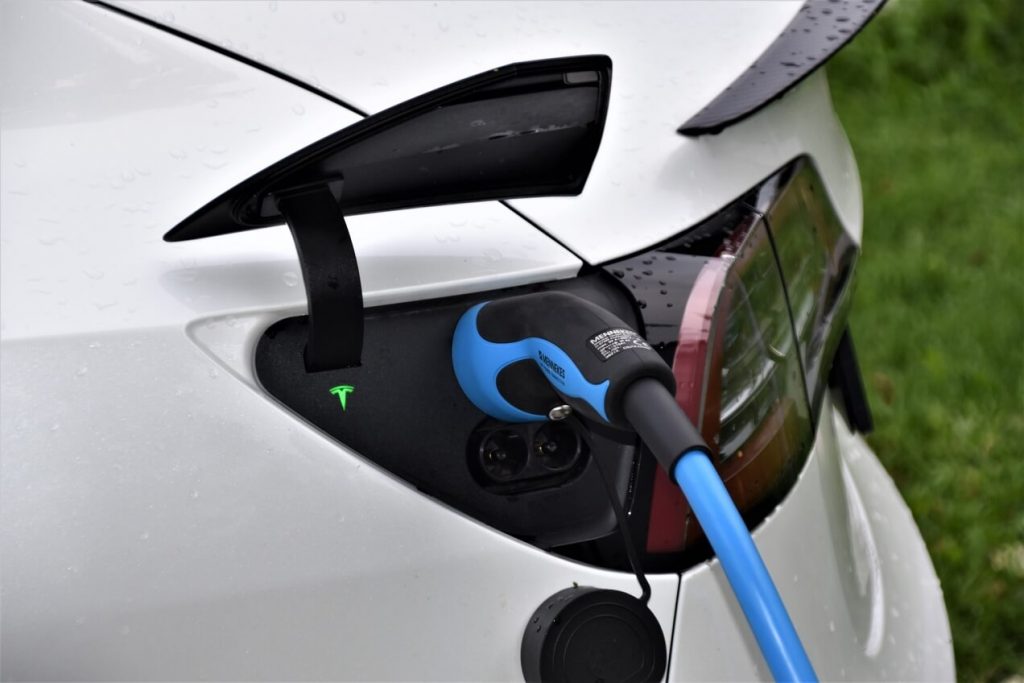
Assessing the carbon footprint of electric vehicles is a complicated processs.
The manufacturing phase
In this phase the main processes are ore mining, material transformation, manufacturing of vehicle components and vehicle assembly. A recent study of car emissions in China estimates emissions for cars with internal combustion engines in the manufacturing phase to be about 10.5 tonnes of carbon dioxide (tCO₂) per car, compared to emissions for an electric car of about 13 tonnes (including the electric car battery manufacturing).
Emissions from the manufacturing of a lithium-nickel-manganese-cobalt-oxide battery alone were estimated to be 3.2 tonnes. If the vehicle life is assumed to be 150,000 kilometres, emissions from the manufacturing phase of an electric car are higher than for fossil-fuelled cars. But for complete life cycle emissions, the study shows that EV emissions are 18% lower than fossil-fuelled cars.
The use phase
In the use phase emissions from an electric car are solely due to its upstream emissions, which depend on how much of the electricity used comes from fossil or renewable sources. The emissions from a fossil-fuelled car are due to both upstream emissions and tailpipe emissions.
Upstream emissions of EVs essentially depend on the share of zero or low-carbon sources in the country’s electricity generation mix. To understand how the emissions of electric cars vary with a country’s renewable electricity share, we should consider Australia and New Zealand.
In 2018, Australia’s share of renewables in electricity generation was about 21% (similar to Greece’s at 22%). In contrast, the share of renewables in New Zealand’s electricity generation mix was about 84% (less than France’s at 90%). Using these data and estimates from a 2018 assessment, electric car upstream emissions (for a battery electric vehicle) in Australia can be estimated to be about 170g of CO₂ per km while upstream emissions in New Zealand are estimated at about 25g of CO₂ per km on average. This shows that using an electric car in New Zealand is likely to be about seven times better in terms of upstream carbon emissions than in Australia.
The above studies show that emissions during the use phase from a fossil-fuelled compact sedan car were about 251g of CO₂ per km. Therefore, the use phase emissions from such a car were about 81g of CO₂ per km higher than those from a grid-recharged EV in Australia, and much worse than the emissions from an electric car in New Zealand.
The recycling phase
The key processes in the recycling phase are vehicle dismantling, vehicle recycling, battery recycling and material recovery. The estimated emissions in this phase, based on a study in China, are about 1.8 tonnes for a fossil-fuelled car and 2.4 tonnes for an electric car (including battery recycling). This difference is mostly due to the emissions from battery recycling which is 0.7 tonnes.
These figures illustrate that electric cars are responsible for more emissions than their petrol counterparts in the recycling phase. But it’s important to note the recycled vehicle components can be used in the manufacturing of future vehicles, and batteries recycled through direct cathode recycling can be used in subsequent batteries. This could have significant emissions reduction benefits in the future.
Overall, on the basis of recent studies, fossil-fuelled cars generally emit more than electric cars when all phases of a life cycle are considered. The total life cycle emissions from a fossil-fuelled car and an electric car in Australia were 333g of CO₂ per km and 273g of CO₂ per km, respectively. That is, using average grid electricity, EVs come out about 18% better in terms of their carbon footprint.
Likewise, electric cars in New Zealand work out a lot better than fossil-fuelled cars in terms of emissions, with life-cycle emissions at about 333 g of CO₂ per km for fossil-fuelled cars and 128g of CO₂ per km for electric cars. In New Zealand, EVs perform about 62% better than fossil cars in carbon footprint terms. Feel free to draw your own political conclusions here…
So, what about old versus new?
Many people would have you believe that the answer to running an environmentally friendly car is to buy something brand new. After all, shouldn’t new cars have the latest technology to reduce emissions and meet the latest standards? The truth is far less clean-cut, especially as ordering a new car requires parts to be sourced and shipped around the world, potentially with a great environmental impact. Also, some of the latest ‘low-emission’ cars may not be as economical in reality as you’d hope.
While a well-maintained car should (in theory) produce the same emissions no matter how old it is, that is not to say it will be better for the environment than a new model. New cars on paper emit less CO2 than older ones due to technological advances, but you have to balance this with the extra energy used up and pollution caused by sourcing the materials for a brand new car, shipping them around the world and building a new car.
If you’re looking to minimise the environmental impact of your car, but are on a budget, however, a used car could actually make more sense. That’s because while the car may have slightly higher official emissions figures, you’re not causing a whole lot more pollution in requiring materials to be sourced and shipped around to enable a brand new car to be built.
So, going for a second-hand car should mean your initial impact on the environment is reduced. But what about the other factors involved in running a car?
Warning, emissions and chemistry talk ahead.
It’s a gas
When a petrol or diesel engine burns fuel, carbon dioxide (CO2) is produced. This CO2 is then emitted through the car’s exhaust pipe. The amount of CO2 a car emits into the atmosphere is measured in grams per kilometre – often shortened to g/km.
CO2 has for a long time been undesirable number one when it comes to greenhouse gas emissions – gases that contribute towards global warming. Of the greenhouse gases cars emit, CO2 makes up a significant majority, posing one of the biggest threats to the planet.
Cars also emit methane (CH4), which although produced in significantly smaller quantities than CO2 is believed to be about 25 times more harmful to the environment over a 100 year period. Therefore, if you want to limit your contribution towards global warming, you need to limit your methane emissions.
At the same time, there are other harmful pollutants that cars emit which are less of a concern for the environment in terms of climate change, but more of an active concern for human health. The big hitters here are carbon monoxide (CO) and nitrogen oxides (NOx).
The latter is not to be confused with nitrous oxides (NxO) which are about 300 times worse as a greenhouse gas than carbon dioxide and are predominantly released during agricultural processes.
So what are the manufacturers doing?
Given we don’t actually manufacture cars in Australia anymore (vale Australian automotive manufacturing), we have to make some global comparisons to see what is going on. According to the United States Environmental Protection Authority, manufacturers have made significant improvements in fuel economy and CO2 emissions between 2013 and 2018. In fact, 11 of the 14 largest manufacturers selling vehicles in the U.S. market improved both estimated real-world CO2 emissions and fuel economy of their new vehicle fleets. One manufacturer, Tesla, improved fuel economy (as measured in miles per gallon of gasoline equivalent, or mpge) but not tailpipe CO2 emissions, because their all-electric fleet produces no tailpipe CO2 emissions. Two of the 14 manufacturers increased CO2 emissions and decreased fuel economy of their new vehicle fleets.
The five year span shown in the following chart covers the approximate length of a vehicle redesign cycle. It is likely that most vehicles have undergone design changes in this period, resulting in a more accurate depiction of recent manufacturer trends than focusing on a single year. The trends shown are due to a combination of vehicle design changes and changes to the distribution of vehicles produced.
Since Tesla produces only electric vehicles, they had by far the lowest tailpipe CO2 emissions, at 0 g/mi, and highest fuel economy, at 113.7 mpge, of all large manufacturers in model year 2018.
Of the remaining manufacturers, Honda had the lowest CO2 emissions and highest fuel economy in model year 2018 and also achieved the largest 5-year improvements in CO2 emissions and fuel economy. Between model years 2013 and 2018, Honda reduced CO2 emissions by 31 g/mi and increased fuel economy by 2.8 mpg. Subaru and Mazda tied for the third lowest CO2 emissions and third highest fuel economy in model year 2018. BMW had the second largest 5 year improvement in CO2 emissions, reducing emissions by 27 g/mi, and Subaru had the third largest improvement, at 26 g/mi. BMW also increased fuel economy by 1.7 mpg, while Subaru increased by 2.2 mpg.
Two manufacturers increased CO2 emissions and reduced average fuel economy over the five-year span. Volkswagen had the largest increase in CO2 emissions, at 11 g/mi, and the largest decrease in fuel economy, at 1.3 mpg, due mostly to a large shift towards SUVs. Fiat Chrysler America (FCA) had the highest new vehicle average CO2 emissions and lowest fuel economy of the large manufacturers in model year 2018, followed by Ford and GM.
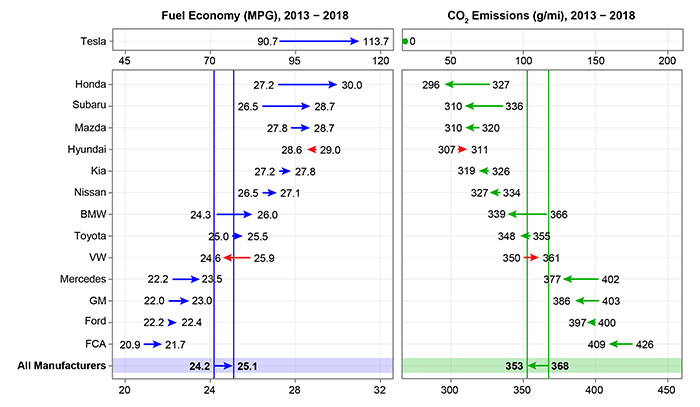
There are significant differences in fuel economy and CO2 emissions between different vehicle manufacturers.
Innovate or die
Technological innovation in the automobile industry has led to a wide array of technology available to manufacturers to achieve CO2 emissions, fuel economy, and performance goals. Engine technologies such as turbocharged engines and gasoline direct injection allow for more efficient engine design and operation. Cylinder deactivation allows for use of only a portion of the engine when less power is needed, while stop/start systems can turn off the engine entirely at idle to save fuel. Hybrid vehicles use a larger battery to recapture braking energy and provide power when necessary, allowing for a smaller, more efficiently operated engine. Transmissions that have more gear ratios, or speeds, allow the engine to more frequently operate near peak efficiency.
Lately, there has been an increased focus on reducing the emissions detrimental to human health rather than just CO2. A knock-on effect of the technology designed to reduce CO and NOx emissions is that more fuel can be burnt, which means more CO2 is produced. It’s a bit of a Catch 22 scenario right now, although carmakers are working on balancing these better.
As a guide, any non-hybrid petrol or diesel car with a CO2 emission figure of under 100 grams per kilometre of driving (typically presented as 100 g/km) should be considered pretty green compared with most cars. Plug-in hybrids should be able to achieve less than half that figure with ‘self-charging’ hybrids sitting somewhere in between. There is a big caveat with plug-in hybrids, however…
Plug-in hybrids only emit far lower emissions than conventional petrol or diesel models if you regularly charge them (most have a claimed electric range of around 50 kms, potentially less on real roads). Fail to charge regularly and plug-in hybrids are likely to be bad for the environment, as once battery charge is depleted they rely on their petrol or diesel engine and also have to carry the weight of the electric motor and batteries around – with extra weight typically resulting in worse fuel consumption and greater emissions.
Yes, you can expect a small boost from the electric motor in a plug-in hybrid if you’re driving around town and the batteries are flat, as braking adds back a little charge, but drive like this and a plug-in hybrid is likely to be pretty inefficient.
Furthermore, plug-in hybrids require more materials to be mined in the first place – not only do they have a petrol or diesel engine, they also have an electric motor and batteries. As a result, there are big question marks over the environmental credentials of plug-in hybrids. The logic behind these models is that they can run with zero emissions around town for short distances – if you charge them regularly – but are also capable of a long trip without having to recharge regularly.
As many standard electric cars now offer a claimed range of more than 300 kilometres, though, these make sense even for drivers who need to do the occasional long journey. And if all your driving is motorway trips of more than 300 kms, then you’re likely to be better off going for a petrol or diesel car than a plug-in hybrid, as you wouldn’t be getting much economy benefit from a plug-in hybrid at higher speeds.
Fudging the figures
When it comes to being environmentally friendly, cars with lower the emissions figures and higher fuel economy are better. Provided a car is properly looked after, its emissions and economy figures shouldn’t get worse as they get older. In fact, in the past it took cars several thousand miles before they were producing maximum power and running with the greatest efficiency.
In saying that, due to official tests being largely conducted in laboratories, the actual economy and emission figures cars are sold with tend to be more optimistic than what you can expect to achieve in the real world. Be aware that over recent years two different types of economy and emissions tests have been used.
For cars registered before September 2018, the ‘NEDC’ economy test was used. This test format didn’t reflect real traffic and driving styles and so claimed fuel economy figures are typically much higher than most drivers are likely to achieve in everyday driving. As a result, from September 2018 onwards, a new more realistic ‘WLTP’ test was phased in for new cars.
This should be much more representative of real roads and traffic, and so you should be able to get closer to this figure with normal driving. All new cars registered from September 2019 onwards should have fuel economy and emissions figures calculated using the more realistic WLTP test. Bearing this in mind, a car that achieves 50mpg on the newer WLTP test is likely to be more economical in everyday driving than one that has a 50mpg figure recorded on the old NEDC test.
For the love of your preferred deity, service your car people!
Okay, I’m checking my white, middle aged male, automotive business owner privilege in here. Servicing your car can be a budget breaker for some and I get that. However, fixing your car when it breaks is worse. Soapbox moment over.
Maintenance has a huge bearing on whether or not a used car is as environmentally friendly as a new one. For starters a car’s emissions are directly related to how much fuel is burned, so an engine which isn’t running properly may emit more pollution than one that is.
Exhaust systems are vital in reducing vehicle emissions. Items such as catalytic converters, particulate filters and exhaust gas recirculation valves all have finite lifespans and will likely need love to insure a used car is keeping its emissions under control. Like all love affairs they have their price, and in older cars with lower values they can be neglected by drivers as replacement parts can be pricey.
When a car is neglected this shortens its useful lifespan. Keep a car well fed and watered and it will last significantly longer than one which isn’t. Since building new cars requires an awful lot of energy, it’s good for the environment to keep older cars running rather than simply building more and more new ones. Scrapping cars takes its toll on the environment as well, especially if they are not disposed of properly.
Is that an elephant I see in the corner?
Obviously, there is a reliability factor with older vehicles that can be very off putting when you know nothing about cars. You have to deal with a mechanic and you have to trust they know what they are doing and have you and your old car’s best interests at heart. A good Technician (formerly known as a mechanic) keeps up to date with training constantly, is networked with other likeminded individuals and asks for help when needed. There is an ever-growing global community of automotive diagnosticians who share their knowledge freely and understand that the industry as a whole is better off for it.
From a customer service point of view, good businesses will test first and replace second, look at your whole car and give you a complete picture. They will give you an up-front quote and will inform you of options to help spread the cost of maintenance and repairs over time. When it comes to complex diagnostic work that has to take into account different systems in a vehicle, they will let you know what evidence they have for the recommendations they have and most distressingly to car owners, tell you that a guaranteed fix may not come from the next step. And they will let you know when you need to report back as part of the testing process and follow up with you to ensure things are going ok.
So, the answer to my conundrum?
Remember way back when I said this article was about my personal journey to environmental inner peace as a bona fide card carrying car guy? Well, like the convoluted pathway that brought you to here (thanks for bearing with me) it’s another pathway again.
My choice is about combining the old, with the not so old. I am embarking on ‘project conundrum’, which is converting a 21 year old Mazda MX5 to be powered by a 2014 model Honda engine. It ticks my boxes for a sporty drive, with more power, recycling some used parts, better fuel economy and a love of cars.
This clearly is not a choice most can make, but I hope that exploring my rationale for not wanting to buy a new electric car has shown you some ways to look at the choices you make.
Author bio
Jeremy Stone is a co-Director of Car Servicing and You Pty Ltd. He originally did an apprenticeship in a small workshop in Elwood, a Suburb of Melbourne, Victoria. His time in the motor industry has included a variety of roles from hands on to management before starting Car Servicing and You in 2010.
A sideroad into studying Psychology and Organisational leadership saw time spent in working in the drug and alcohol sector as well as with prisoners and their families. He has 2 children with his partner Fiona and lives on the Mornington Peninsula.